JEFF YAP
Industrial designer
Work
About
Résumé
Selected work · ONTRA
FUTURE MOBILITY / PREMIUM RAIL EXPERIENCE
ONTRA
An adaptable rail suite
for work, rest and collaboration.

2026 · 6 months
Industrial design / Jeff Yap
Team project · Future rail concept
The future of productivity
= adaptability.
As work becomes less tied to one location, travel can become a third space for focus, recovery and connection.
Set within a future Pan-Asia rail scenario linking mainland Southeast Asia and southern China, ONTRA explores a personal suite that adapts as intentions change.
01 / THE PREMISE
Mobility as a third space.
Digital nomadism and location-flexible work invite a different view of travel: the journey can become part of everyday life.
02 / ONE SUITE · THREE MODES
Work. Rest. Collaborate.
Explore the physical transition between Work and Rest, then see how Collaboration extends the suite toward shared attention.
Switch between Work and Rest

SURFACE + ORIENTATION
Room to find your focus.
Bring the surface, personal device and panoramic interface into one field of attention. A defined personal territory supports focused work and shorter tasks within the same footprint.
The working surface gathers devices and everyday belongings around an upright posture.
Work Mode
↗

Rest Mode
↗
COLLABORATION MODE
Make room for shared attention.
The panoramic interface gives conversations and shared content a larger presence within the suite. Together with the opening partition explored in the layout studies, collaboration becomes a choice alongside individual work and rest.

Fully lowered / An open boundary for shared activity.
Privacy at the height you need.
The separator can be fully raised to close the boundary, partially lowered to open a shared view, or completely lowered to connect the adjacent spaces. Passengers can adjust the degree of separation to suit focused work, conversation or shared activity.
The 60° rotation and sliding partition appear in the concept development. Movement, clearance and control behaviour remain design proposals.
Change posture. Keep essentials close.
The design intent is continuity: the main surface changes with the activity, while devices, controls and belongings retain a predictable place. The full-scale mock-ups later in the study explore these relationships at human scale.

Solid / left arm · Dashed / right arm · Darker overlap / shared coverage
Illustrative reach study. Body dimensions, surface heights and obstruction clearances remain to be validated.
WORK POSTURE
REST POSTURE
01
Work surface
Frequent tasks sit in front of the passenger, within the intended comfortable reach area.
02
Devices & charging
A separate side surface keeps personal electronics close and the main work area available.
03
Controls across modes
The inclined console is intended to remain accessible in both postures. Its angle distinguishes controls from surfaces used to set down objects.
04
Personal storage
Wallets, bottles and snacks have a dedicated place, separate from work and controls.
03 / ERGONOMICS & FUNCTIONAL ZONING
A place for every action.
The layout separates work, devices, controls and personal belongings. These reach studies explore what remains accessible as the passenger turns from work toward rest.
04 / CABIN CONFIGURATIONS
Choice at the scale of the cabin.
ONTRA extends adaptability from the individual suite to the cabin layout. Two suite types can be arranged across both sides of the aisle, or paired with shared seating in an alternative configuration.
A FAMILY OF SUITES
Two suite types.
ONTRA Suite brings Work, Rest and Collaboration together, with a pivoting seat that enables the transition into Rest Mode.
ONTRA Core retains the same underlying suite design without Rest Mode. Its seat stays in a fixed orientation, so no pivoting mechanism is needed.
Two ways to arrange the cabin.
LAYOUT A / SUITE CABIN
ONTRA Suite and ONTRA Core occupy both sides of the central aisle, offering individual spaces within a consistent cabin arrangement.

Suite cabin / Individual spaces on both sides of the aisle.
CABIN PLAN
ONTRA Suite · ONTRA Core · Central aisle

Alternative cabin planning proposals. Seating capacity and operational performance have not been evaluated.

Seat-side adjustment / A tactile control integrated beside the seat.

Workspace console / Devices and controls grouped beside the main surface.

Occupied suite / The seat and surrounding surfaces in use.

Headrest study / Speaker modules could sit beneath the headrest; placement and acoustics remain exploratory.
05 / PHYSICAL INTERACTION
Details within reach.
Physical controls and seating details give adjustment a tangible place in the suite. The seat and workspace controls sit within reach, while the occupied view and headrest study show how those details meet the passenger.
06 / WORKING AT FULL SCALE
From a line on the floor to an occupied space.
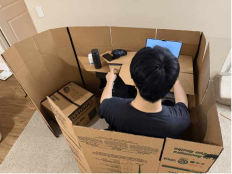
Tape, loose furniture and cardboard made the spatial questions tangible. The mock-ups show how a person, a laptop and everyday belongings occupy different arrangements before the proposal is resolved in detail.
SPACE MOCK-UP

Spatial mock-ups / Work, shared seating and rest arrangements explored at human scale.
OCCUPIED PROTOTYPE

Work surface / Devices and belongings within the enclosure.

Rest posture / The body turns within the same footprint.

Work posture / Surface position relative to the seated body.
Reach / The relationship between hand, surface and side console.
Market positioning
LEISURE & HOSPITALITY
PRODUCTIVITY & ADAPTABILITY
UTILITY SERVICE
EXPERIENCE PLATFORM
→
↑





Qualitative positioning from the project research. ONTRA explores the opportunity to connect activities within one adaptable personal space.
Design direction / Coordinate posture and surfaces, keep essentials accessible, and let passengers choose privacy or connection.

Earlier suite iteration / Seat form, side controls and enclosure explored together.

Earlier suite iteration / Work surfaces, partition and seated relationships developed at suite scale.
Developing the suite in detail.
Past mid-to-high-fidelity versions brought the seat, work surface and enclosure into a more resolved visual form. These studies record the design's development before the current proposal.

Suite layouts / Orientation, entry and opening boundaries.
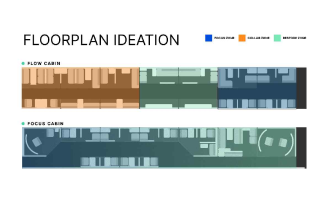
Cabin zoning / Focus, collaboration and restoration.

Cabin configurations / Comparing focus and flow.
Connecting suite and cabin.
Plan studies explored the 60° seat rotation, folding and sliding surfaces, opening partition, and arrangements for focus, collaboration and restoration across the cabin.

Early concepts / Seats, surfaces and personal territory.

Seat development / Profile, support and posture.
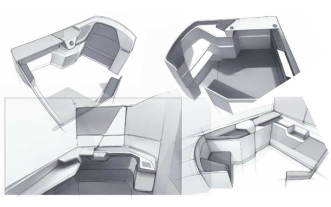
Suite development / Enclosure and working surface.
Exploring the suite.
Seat, surface and enclosure were explored together. Select an image to inspect the original study.
Passenger priorities shaped the brief.
Three passenger archetypes span early adopters, the early majority and the late majority. Their different priorities informed privacy, connection by choice, and a clear transition between work and rest. The paired images below are visual references from the project’s user-needs board, showing desired situations rather than results from testing the suite.

DISCOVERY & CONNECTION
Experience Seeker
EARLY ADOPTERS
Values spontaneity, memorable experiences and playful productivity. Social contact should be easy to enter—and easy to leave.
DESIGN RESPONSE
Opening boundaries and shared displays make collaboration a choice within the journey.

Playful productivity

Social discovery

FOCUS & RECOVERY
Hybrid Professional
EARLY MAJORITY
Needs deep productivity, trusted personal territory and privacy, with the ability to recover between demanding tasks.
DESIGN RESPONSE
A defined suite, a purposeful work orientation and a distinct rest posture support those shifts.

Focused work

Rapid recovery


Short work bursts

Leisure as reward
A CLEAR CHANGE OF PACE
Bleisure Traveler
LATE MAJORITY
Moves between short work sessions and leisure. Belongings stay close, while a change of setting helps mark a task as finished.
DESIGN RESPONSE
Seat rotation, changing surfaces and accessible storage let the same footprint serve different intentions.
From passenger needs to spatial moves.
Focus, recovery and connection are not separate passenger types or fixed moments. They can follow one another in a single journey, so the suite needs to change with the activity.
FOCUS → RECOVERY
↓
Pivoting seat
A proposed 60° turn shifts the ONTRA Suite from a work-facing orientation toward rest, making the change of activity spatially legible.
SHORT TASKS → PAUSE
↓
Changing work surface
The work surface supports devices and belongings when needed, then clears the main field of attention as the passenger changes mode.
PRIVACY ↔ CONNECTION
↓
Adjustable separator
The boundary can close for focus, lower partway for conversation, or lower fully for shared activity.
These are design responses to the stated needs, not validated mechanisms. ONTRA Core keeps a fixed seat and omits Rest Mode; movement and clearances of the Suite remain to be tested.

Research / Signals, references and passenger experiences.

Synthesis / Exploring directions and grouping recurring themes.
Framing the experience.
Early reference gathering and affinity mapping informed the passenger archetypes and the direction of the concept.
PRECEDENTS → SPATIAL CRITERIA
Translating references into design criteria.
Rail precedents informed three spatial priorities for ONTRA.

EUROSTAR PREMIER
A table is only a start.
The reference supports laptop use. ONTRA expands the workspace to include devices, belongings and movement.

JR EAST GRANCLASS
Different activities need different postures.
Reclining seating prioritises comfort. ONTRA coordinates seat orientation with the task surface.

ITALO SALOTTO
Sharing should remain a choice.
A group compartment supports meeting and conversation. ONTRA explores connection while preserving each passenger’s personal space.
FOUR CONVERGING DRIVERS
Lower-carbon mobility
Rail provided the context for exploring productive travel.
Location-independent work
Work can move beyond the office and into the journey.
Blending work and leisure
A single trip may call for focus, recovery and connection.
Adaptive environments
Personal spaces should respond when activities change.
OPPORTUNITY
The future of productivity
= adaptability.
The opportunity is to connect activities within one adaptable personal space. Passengers should be able to change posture, task and degree of privacy while keeping their essentials close.
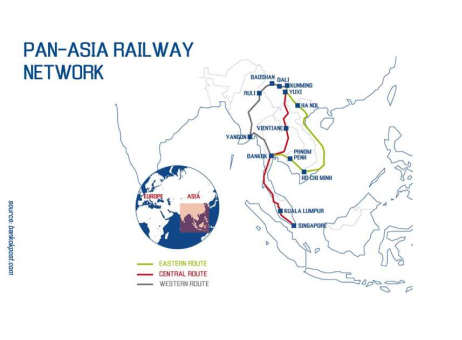
FUTURE PAN-ASIA RAIL
A future mainland Southeast Asia–southern China scenario. Longer cross-border journeys create an opportunity to make time between destinations part of everyday life.
Geographic reference for the concept; not a claim of an operational network or confirmed completion date.
07 / DESIGN DEVELOPMENT
From research to spatial decisions.
A scan of travel, work and hospitality trends led to one question: how can a personal rail space adapt as passengers change activities? Rail precedents then helped translate that opportunity into spatial criteria.
Industrial design
Jeff Yap
Branding design
Mika Hu
UI design
Daniel Gu
2026 · 6 months
Team concept project
Working imagery · Final renders in development.
Jeff Yap
Industrial design · 2026
Selected work ↗
About
Résumé
Let’s talk ↗
ONTRA